
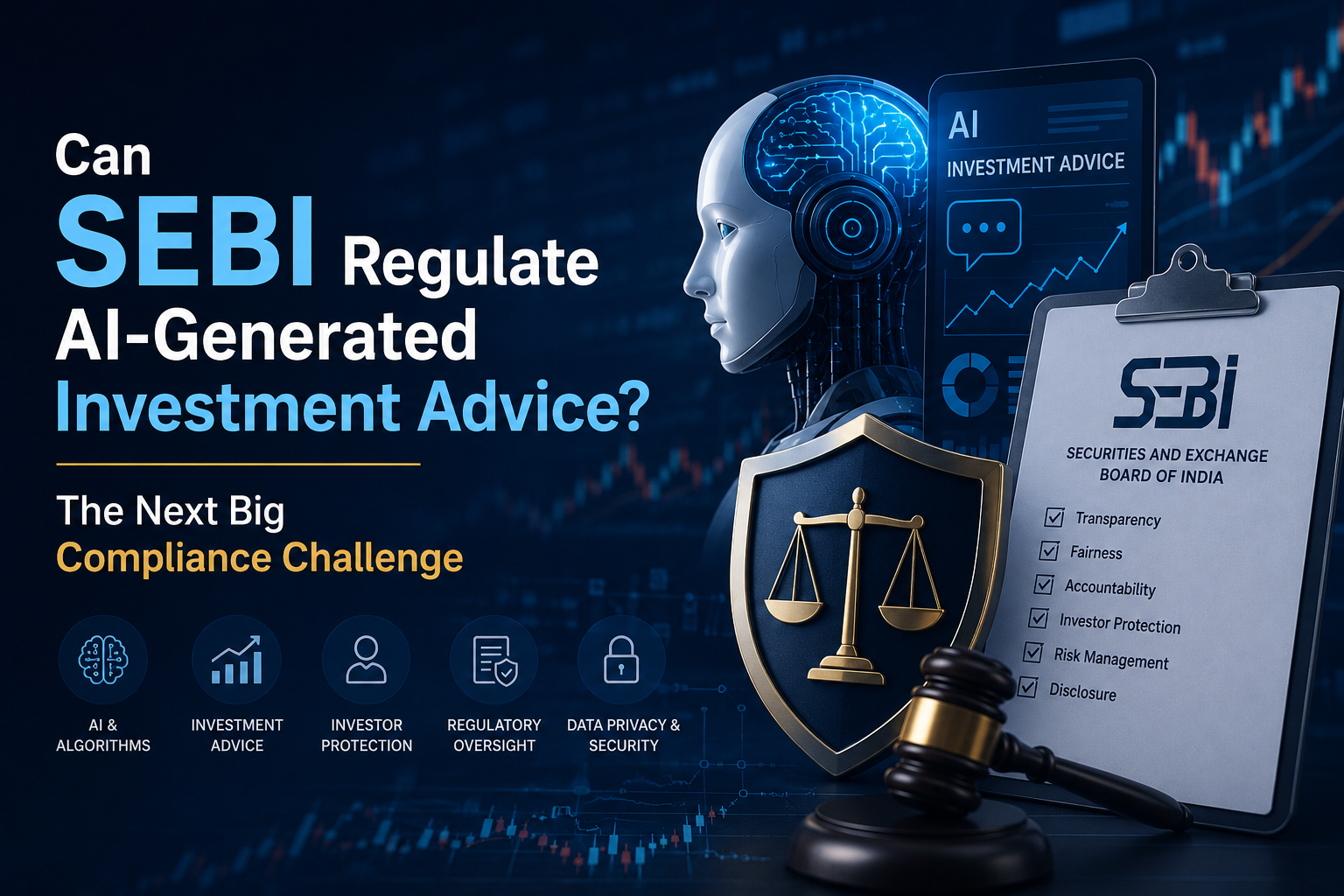
Every stock market app in India today claims to use artificial intelligence. AI-powered screeners, AI-driven alerts, AI chatbots answering investor queries, and automated tools generating buy-sell recommendations - the technology is everywhere. But a question that most of these platforms have not yet answered clearly is: when AI generates investment advice, who is legally responsible? And can SEBI actually regulate something it cannot register?
This is not a theoretical debate. In June 2025, SEBI released a landmark consultation paper on the responsible use of AI and machine learning in Indian securities markets - becoming one of the first financial regulators in India to lay out an AI-specific governance roadmap. The January 2025 guidelines for Research Analysts already mandated disclosure of AI tool usage to clients. And SEBI has made its broader position clear: using AI does not reduce regulatory responsibility. It increases it.
For RIAs, Research Analysts, fintech platforms, algo trading businesses, and any financial firm deploying AI in its advisory workflow, the compliance implications are significant and immediate. This article explains where SEBI's framework currently stands, what the accountability gaps are, and what firms need to do to stay compliant as the regulatory landscape evolves.
The core problem: AI cannot be registered with SEBI
To understand why AI-generated investment advice creates such a difficult compliance challenge, you have to start with the foundational structure of SEBI's regulatory framework.
Under the SEBI (Investment Advisers) Regulations, 2013 and the SEBI (Research Analysts) Regulations, 2014, investment advice and research reports must be attributed to and signed off by a named, SEBI-registered individual. Registration requires qualifications, certifications, disclosures, and ongoing compliance obligations - all of which presuppose a human being who can be held accountable.
An AI system cannot be registered with SEBI. It cannot take the NISM certification exam. It cannot sign a research report. It cannot be penalised, suspended, or deregistered. And critically, it cannot be held accountable for a recommendation that results in investor loss.
This creates what regulators and legal commentators are increasingly calling the accountability gap - the space between what AI can produce and who the law can actually hold responsible for it. Under SEBI's current framework, this gap is bridged by a simple but consequential rule: the registered human professional is fully accountable for every output that AI generates on their platform or in their name.
What SEBI has done so far: a timeline
SEBI's approach to AI in financial markets has moved from general awareness to specific regulatory action over the past two years. Here is where things stand as of mid-2026.
January 2025: AI disclosure mandated for Research Analysts
The SEBI Guidelines for Research Analysts, issued on January 8, 2025, introduced the first explicit AI-specific compliance obligation. Research Analysts are now required to disclose to clients the extent to which they use AI tools in their research services. This disclosure must be made at the time of sharing terms and conditions, and updated whenever the extent of AI use changes. For existing clients, full compliance with this disclosure requirement was mandated by April 30, 2025.
This is more significant than it may appear. It establishes the principle that AI is a material factor that clients have a right to know about - not a back-office tool that can be used invisibly.
January 2025: Investment Advisers made accountable for AI outputs
The December 2024 amendments to the IA Regulations, followed by SEBI's January 2025 guidelines, pinned explicit responsibility on Investment Advisers for the accuracy, security, confidentiality, and integrity of AI-generated advice. The guidelines state clearly that an adviser cannot blame algorithmic errors or machine predictions for incorrect or misleading advice given through AI tools. The registered adviser is fully accountable.
June 2025: SEBI's AI/ML Consultation Paper
On June 20, 2025, SEBI released its consultation paper titled "Guidelines for Responsible Usage of AI/ML in Indian Securities Markets" - a 37-page document that represents the most comprehensive statement of SEBI's thinking on AI governance to date.
The paper built its governance framework around six core pillars: ethics, accountability, transparency, auditability, data privacy, and fairness. It proposed that regulated entities must:
• Establish board-approved AI governance frameworks with senior management accountability
• Maintain skilled internal teams capable of overseeing AI and ML deployments throughout their full lifecycle
• Conduct independent audits and periodic reporting of AI model accuracy results to SEBI
• Ensure traceability of AI reasoning and model functioning - meaning firms must be able to explain how an AI arrived at a recommendation
• Execute robust agreements with third-party AI vendors and maintain fallback plans
• Ensure that data used in AI models is of high quality and free from bias
Importantly, the consultation paper explicitly held regulated entities accountable for the outputs generated by AI and ML tools, not just the processes behind them. SEBI aligned its proposed framework with global regulatory practices from FINRA in the United States, MAS in Singapore, and ASIC in Australia - signalling that the direction of travel is international best practice, not a lighter domestic standard.
2026: SEBI using AI to monitor AI
In a notable development reported in February 2026, SEBI Chairman Tuhin Kanta Pandey confirmed that SEBI itself is now deploying AI to track financial influencers, monitor investment advice on social media, and review advertisements for regulatory compliance in real time. This matters for two reasons. First, it means that AI-generated advice that does not meet disclosure and accountability standards is increasingly likely to be detected. Second, it signals that SEBI is building the enforcement infrastructure to match its regulatory ambitions.
The three biggest compliance gaps for firms using AI
Despite SEBI's progress, the consultation paper itself acknowledged that several critical questions remain unresolved. These are the compliance gaps that firms and their advisors need to think carefully about right now.
- Who is accountable when a third-party AI model gives wrong advice?
For firms using third-party AI tools or embedding AI APIs into their advisory workflows, this is not a hypothetical risk. It is a present one. The compliance obligation is to ensure that contractual agreements with AI vendors clearly address data quality, model accuracy, liability allocation, and audit access.
- What counts as "investment advice" when AI is involved?
These questions do not yet have definitive regulatory answers. But SEBI's enforcement trajectory - including the ₹546 crore action against Avadhut Sathe's trading academy in December 2025 for providing unregistered advisory services under the guise of education - suggests that the regulator will apply a broad interpretation. If an AI output could reasonably lead an investor to buy, sell, or hold a security, SEBI is likely to treat it as investment advice, regardless of how the platform labels it.
- Can AI reasoning be made auditable?
SEBI has not yet specified exactly what auditability means in technical terms, or how it will assess whether a firm's AI is sufficiently traceable. But the direction is clear: firms that cannot explain their AI recommendations, or that use models whose outputs are opaque by design, will face increasing compliance risk as SEBI's framework matures.
What firms must do right now
The absence of a final, comprehensive AI regulation from SEBI does not mean the compliance obligation is unclear. Based on the January 2025 guidelines, the June 2025 consultation paper, and SEBI's broader enforcement direction, firms using AI in any part of their advisory or research workflow should take the following steps immediately.
Disclose AI usage to clients - clearly and specifically
This is now a mandatory obligation for Research Analysts and effectively expected of Investment Advisers. The disclosure should explain what AI tools are used, in what part of the research or advisory process, and what human oversight exists. A vague statement that the firm "uses technology to enhance its services" is not sufficient. SEBI expects clients to understand the nature and extent of AI involvement.
Ensure a named, registered professional takes ownership of every AI output
No AI-generated recommendation should reach a client without being validated and owned by a named, SEBI-registered Research Analyst or Investment Adviser. This person's name and registration number should be disclosed in the research report or advisory output, exactly as it would be for a human-only recommendation. If your platform cannot identify which registered professional is accountable for each output, the disclosure and accountability framework is inadequate.
Build a board-approved AI governance policy
Even before SEBI finalises its AI/ML framework, firms that use AI meaningfully in their operations should have a documented, board-approved AI governance policy. This policy should cover: which AI tools are used and for what purposes, how models are selected and tested before deployment, how model performance is monitored on an ongoing basis, what human review processes exist before AI outputs reach clients, and what the firm does when an AI output is found to be inaccurate.
Audit your third-party AI vendor agreements
If your firm uses AI tools built by a third party, review your agreements with those vendors against SEBI's expectations. The agreement should address data quality standards, accuracy representations, the vendor's obligations when the model produces errors, audit access rights, and data confidentiality. Relying on a standard software terms-of-service agreement is unlikely to be sufficient under SEBI's proposed framework.
Map all AI touchpoints in your client journey
Conduct a complete review of everywhere that AI is involved in how your firm interacts with clients or generates outputs - screening tools, chatbots, recommendation engines, portfolio construction models, risk profiling questionnaires with automated outputs, and market alerts. For each touchpoint, identify the compliance obligations that apply, the registered professional accountable for that output, and the disclosure that needs to be made.
How other regulators are approaching the same problem
SEBI is not alone in grappling with this challenge, and India can learn from how other regulators have moved.
FINRA in the United States has issued guidance making clear that broker-dealers are responsible for AI-generated communications to clients, and that supervisory obligations apply regardless of whether a recommendation is generated by a human or an algorithm. The SEC has similarly clarified that the use of AI does not relieve investment advisers of their fiduciary duty.
MAS in Singapore has issued guidelines on the use of AI and data analytics that emphasise model explainability, human accountability, and fair treatment of customers - principles closely mirrored in SEBI's consultation paper.
What the Indian regulatory framework has that many of these jurisdictions do not is a particularly sharp accountability rule: the registered individual, not the firm abstractly, must own the output. This makes Indian AI compliance more personal and more specific than in some comparable markets - and raises the stakes for registered professionals who deploy AI tools in their practice without adequate oversight structures.
The path forward: what a final SEBI AI framework might look like
Based on the June 2025 consultation paper and SEBI's broader regulatory direction, a finalised AI framework for Indian securities markets is likely to include some version of the following elements.
A mandatory board-level AI governance policy for all regulated entities above a certain size or using AI above a certain level of material impact. Mandatory disclosure to SEBI - not just clients - of which AI tools are in use and periodic reporting of model accuracy. Registration or empanelment requirements for high-risk AI tools, potentially including third-party model providers serving regulated entities. Specific technical standards for auditability and explainability, potentially by AI risk category. Inspection checklists that include AI governance as a standard review area, alongside the existing compliance policy, client documentation, and grievance handling reviews.
Firms that build these structures now - before the final framework is mandated - will be significantly better positioned than those that wait for the regulation to force a retrofit.
Conclusion
SEBI can regulate AI-generated investment advice, and it is actively doing so. The accountability principle is already established: the registered human professional is responsible for every AI-generated output that reaches a client, regardless of whether they personally generated it. The disclosure obligation is already mandatory for Research Analysts. The governance framework is being built through the consultation process. And SEBI is now using AI itself to enforce these standards.
The question for firms is not whether regulation is coming. It is whether their compliance infrastructure is ready for the level of scrutiny that AI deployment will attract. For RIAs, Research Analysts, fintech platforms, and algo trading businesses, the time to build an AI governance framework is now - not after the first inspection notice arrives.
If your firm uses AI tools in its advisory or research workflow and needs guidance on disclosure obligations, governance frameworks, or AI compliance readiness, speak with our SEBI compliance team before your next product update or client communication.
Frequently asked questions
- Can SEBI regulate AI-generated investment advice?
- Is AI-generated investment advice legal in India?
- What did SEBI's June 2025 consultation paper say about AI?
- Do Research Analysts need to disclose AI usage to clients?
- Who is accountable if an AI tool gives wrong investment advice?
- What is the accountability gap in AI investment advice regulation?
- Does SEBI require a board-approved AI governance framework?
- How should firms handle third-party AI tools from vendors?
- What does SEBI mean by AI model auditability?
- Is robo-advisory regulated by SEBI?
- What happens if a fintech uses AI for investment advice without SEBI registration?
- What should RIAs and RAs do right now to prepare for SEBI's AI framework?