
Introduction
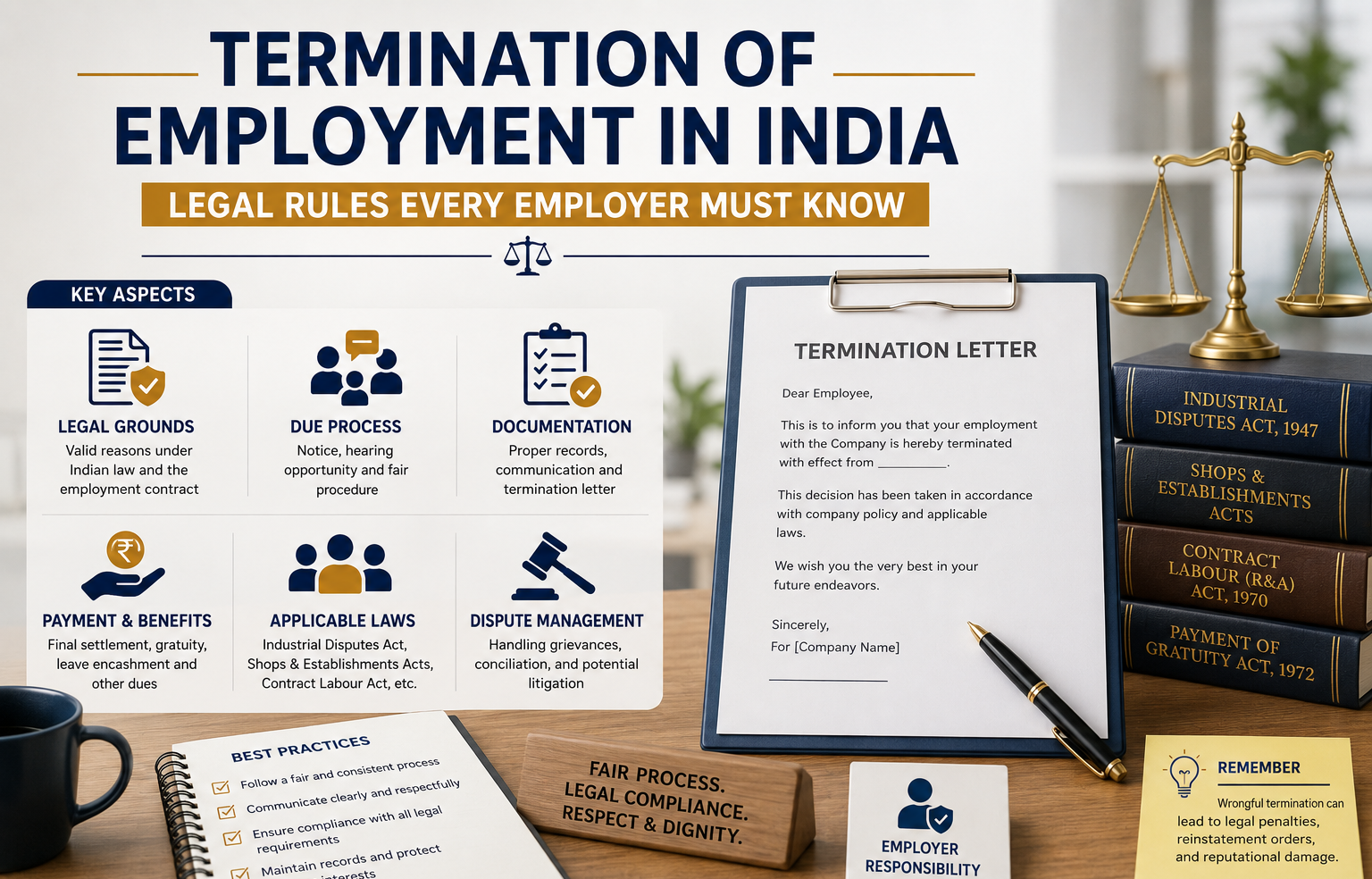
Termination of employment is one of the most legally sensitive areas of workplace management in India. Unlike many jurisdictions with a single overarching employment statute, India's framework is layered across multiple central and state laws. Employers who fail to follow the correct procedures face exposure to labour litigation, penalties, reinstatement orders, and reputational damage.
This article explains the key legal rules governing employment termination in India, with specific reference to the applicable statutory framework, the critical workman vs non-workman distinction, and best practices for legally compliant exits.
The Legal Framework - Key Statutes
There is no single statute governing all employment terminations in India. The applicable law depends primarily on whether the employee is classified as a 'workman' under the Industrial Disputes Act, 1947.
Industrial Relations Code, 2020 (IR Code) - Replacing the IDA
The IR Code, 2020 is the primary statute governing termination of workers (replacing the old IDA). The definition of ‘worker’ under the IR Code broadly mirrors the IDA: any person employed in an industry for manual, unskilled, skilled, technical, operational, clerical, or supervisory work, but excluding those employed in a managerial or administrative capacity.
Key IR Code provisions relevant to termination (replacing former IDA provisions):
• Section 25F - Retrenchment of workmen requires: one month's notice or pay in lieu; retrenchment compensation at 15 days' average pay per completed year of service; and prior intimation to the appropriate government authority.
• Section 72 (IR Code, formerly Section 25G of the IDA) - Last-come-first-go principle applies for retrenchment unless otherwise agreed, with written reasons required for any departure.
• Section 77 (IR Code, formerly Section 25N of the IDA) - Prior government permission before retrenchment, closure, or lay-off is now required for establishments employing 300 or more workers (up from 100 under the old IDA). This raised threshold is a significant change: many mid-sized employers who previously needed government approval before retrenchment no longer do. States may, however, notify a lower threshold for their jurisdiction.
• Section 105 (IR Code, formerly Section 11A of the IDA) - Industrial Tribunals can substitute dismissal with a lesser penalty if found disproportionate to the misconduct alleged.
Shops and Establishments Acts
Each state has its own Shops and Establishments Act governing working conditions, notice periods, and termination procedures for employees in commercial establishments (offices, shops, restaurants, etc.). These acts apply to both workmen and non-workmen and typically prescribe minimum notice periods and conditions for termination. Employers must check the specific Act applicable in their state.
Labour Codes 2019-2020
The central government has enacted four Labour Codes - the Industrial Relations Code, 2020; the Code on Wages, 2019; the Social Security Code, 2020; and the Occupational Safety, Health and Working Conditions Code, 2020 - which consolidate and replace 44 existing central labour laws. All four Labour Codes were notified and brought into force with effect from 21 November 2025, through a notification by the Ministry of Labour and Employment. This is the most significant reform of India’s labour framework in decades, consolidating 29 central labour laws (including the Industrial Disputes Act, 1947, the Payment of Wages Act, 1936, and the Factories Act, 1948) into four codes. As of May 2026, the codes are operative. Draft central rules were published in December 2025, with final central rules expected in 2026; state-level rule notifications are at varying stages. Employers should monitor applicable state notifications for precise procedural compliance requirements, as certain provisions require state-specific rules before they become fully enforceable.
Employment Contracts and Standing Orders
The Industrial Employment (Standing Orders) Act, 1946 has been subsumed into the Industrial Relations Code, 2020. Under the IR Code, Standing Orders are mandatory for establishments with 300 or more workers (raised from 100 under the old Act). Employers may adopt the Model Standing Orders issued by the Central Government. Employment contracts and HR policies supplement but cannot contradict the statutory minimum standards. Employment contracts and HR policies supplement (but cannot contradict) the statutory minimum standards.
The Critical Distinction: Workman vs Non-Workman
The workman/non-workman distinction is the most important variable in Indian employment termination law:
• Workers (formerly ‘workmen’ under the IDA): Subject to the protections of the IR Code, 2020, including mandatory retrenchment compensation, Reskilling Fund contributions, government approval requirements (now for establishments with 300+ workers), and the right to challenge termination before Industrial Tribunals.
• Non-workmen (managerial/administrative employees): Governed primarily by their employment contracts and applicable Shops and Establishments Acts. Do not benefit from IR Code worker protections in the same way, but can still bring civil suits for wrongful termination and are protected by their employment contracts and applicable Shops and Establishments Acts.
Many employers err by applying the same termination procedure to all employees. Senior managers and executives are typically non-workmen; field staff, support staff, clerks, and most IT/technical workers are likely to be workmen even if on high salaries.
Principles of Natural Justice in Misconduct Terminations
For both workmen and non-workmen, termination for misconduct carries legal risk unless the employer follows principles of natural justice. This means:
• Issuing a charge sheet (show cause notice) setting out the alleged misconduct
• Giving the employee a reasonable opportunity to respond
• Conducting a fair, impartial domestic inquiry with proper documentation
• Passing a reasoned order based on evidence
Courts and labour tribunals have consistently held that termination without following these principles is illegal - regardless of the seriousness of the misconduct alleged.
Notice Period Rules
Notice period obligations may arise from the employment contract, applicable Shops and Establishments Act or the Industrial Relations Code, 2020. Key points:
• The IR Code (Section 70) requires one month's notice (or pay in lieu) for retrenchment of workers who have completed one year of continuous service.
• Most Shops and Establishments Acts prescribe minimum notice periods of 30 days for termination after a qualifying period of service.
• Notice periods in employment contracts for senior employees are typically longer (60 to 90 days or more) and are contractually enforceable.
• Garden leave provisions - where an employee is kept away from work during the notice period - are permissible if contractually agreed.
Retrenchment Compensation
Under the IR Code, 2020 (Section 70), workers retrenched after completing at least one year of continuous service are entitled to retrenchment compensation equivalent to 15 days' average pay for each completed year of service (or part thereof in excess of six months). This compensation is in addition to notice pay and must be paid before retrenchment takes effect.
Data Security and IT Access Risks During Exits
For fintech, technology, and digital businesses, employee exits carry cybersecurity risks that are as significant as the legal compliance requirements:
• Revoke all system access (email, VPN, cloud applications, code repositories) on or before the last working day
• Recover company devices including laptops, mobile phones, and storage media
• Disable privileged credentials and reset shared passwords
• Review for unusual data downloads or transfers in the weeks preceding the exit
• Enforce NDA, IP assignment, and confidentiality obligations through the exit documentation
Best Practices for Legally Compliant Terminations
• Maintain up-to-date written HR policies aligned with applicable Shops and Establishments Act and Standing Orders
• Keep a complete employment record - employment contract, performance reviews, warnings, disciplinary communications, and exit documentation
• For misconduct-related terminations, always follow the domestic inquiry process regardless of how clear-cut the case appears
• Obtain legal advice before terminating senior employees, during workforce restructuring, or in any case involving potential IR Code worker protections
• Integrate IT access revocation into the HR exit checklist
• Process full and final settlement (FnF) within the timeline prescribed by the applicable Shops and Establishments Act
Frequently Asked Questions
Can an employer terminate a worker without following the IR Code procedure?
No. Termination of a worker without following applicable Industrial Relations Code, 2020 requirements - notice, retrenchment compensation, Reskilling Fund contribution, and inquiry process for misconduct - is illegal and exposes the employer to reinstatement orders and back wages. Penalties under the IR Code for non-compliance with retrenchment conditions are also significantly higher than under the old IDA.
What is the difference between retrenchment and termination for misconduct?
Retrenchment under the IR Code is termination for economic or operational reasons (surplus staff, restructuring) and requires compensation, notice, and a Reskilling Fund contribution. Termination for misconduct requires a domestic inquiry process but does not require retrenchment compensation. The procedures and consequences differ significantly.
Conclusion
Termination of employment in India is legally complex, highly fact-specific, and regulated by multiple overlapping statutes that vary by state, industry, and employee category. The workman/non-workman distinction is foundational, and the principles of natural justice apply broadly. Businesses - particularly those scaling quickly in technology and financial services - should ensure their HR policies, employment contracts, and exit procedures are legally robust.
At KP Regtech, we assist businesses with compliance advisory, governance frameworks, policy documentation, and risk management solutions designed to support organisations operating in dynamic regulatory environments.