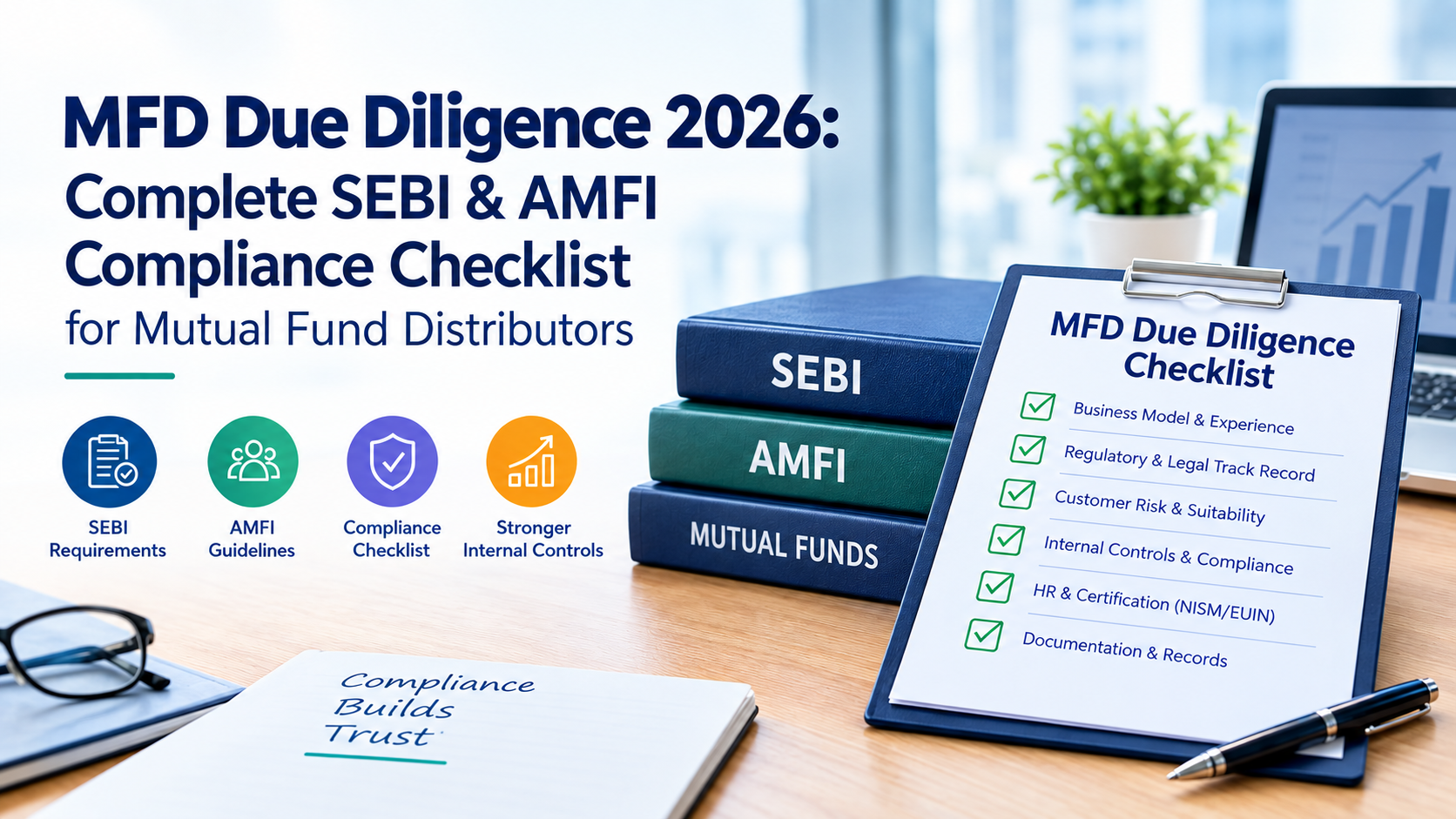
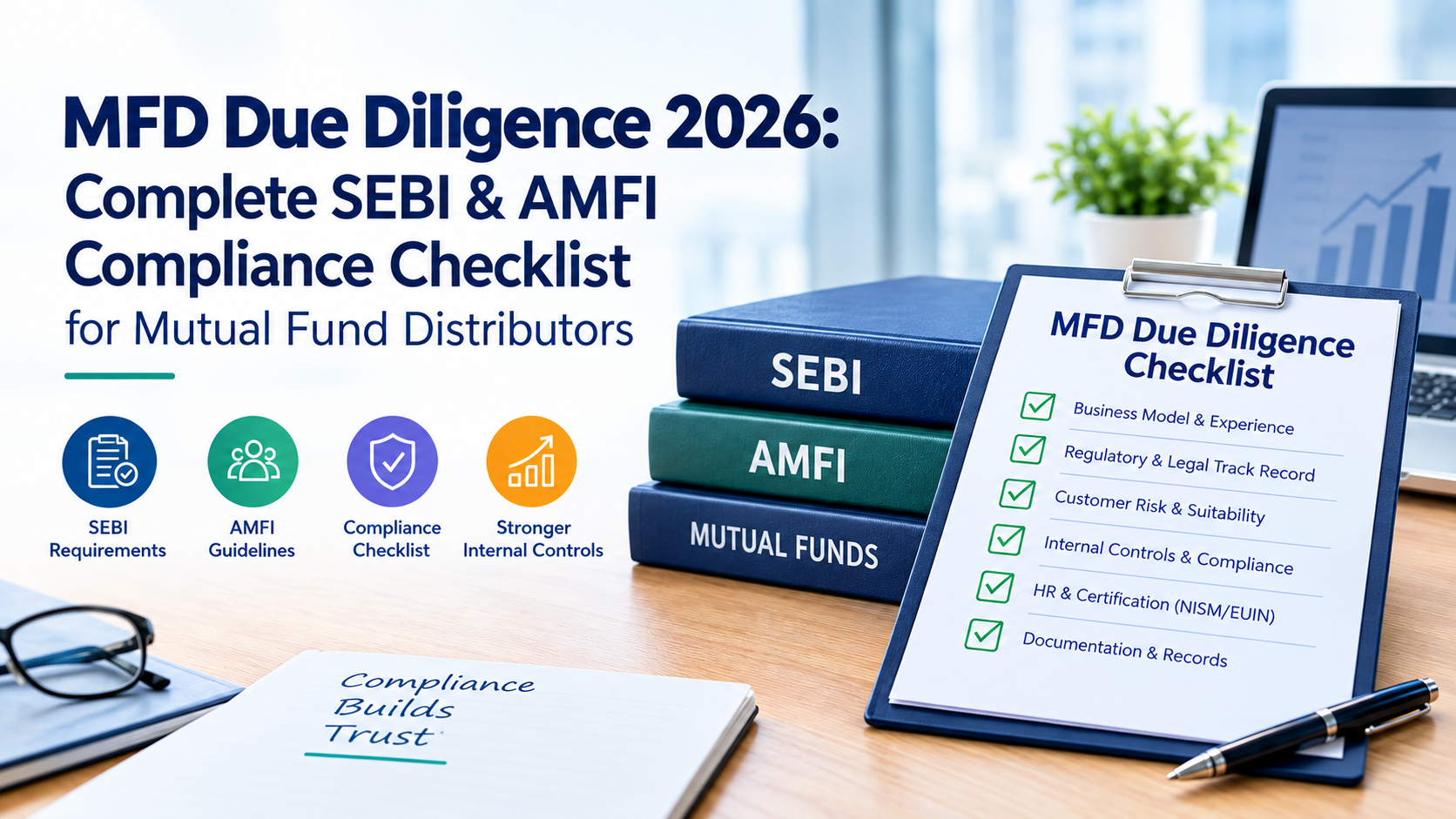
As the mutual fund distribution business grows in scale and complexity, Mutual Fund Distributors (MFDs) are increasingly expected to maintain appropriate systems, processes, records and controls to demonstrate that their business is conducted with reasonable care.
For qualifying Mutual Fund Distributors, MFD due diligence is a key regulatory and compliance exercise undertaken by Mutual Fund Asset Management Companies (AMCs) to assess a distributor's business practices, internal controls, compliance framework and adherence to applicable regulatory requirements and the AMFI Code of Conduct.
The current SEBI Master Circular for Mutual Funds, dated March 20, 2026, sets out specific provisions relating to due diligence of Mutual Fund Distributors under Chapter 16. SEBI requires AMCs to put in place a due diligence process for distributors, while permitting AMCs to take assistance from an agency of repute in carrying out the process.
For an MFD, due diligence should never be treated as a questionnaire-filling exercise alone. It is an opportunity to assess whether the distributor's operations, client servicing, risk profiling, suitability processes, compliance controls, employee certifications, grievance handling and documentation are properly structured and supported by evidence.
What Is MFD Due Diligence?
MFD due diligence (Mutual Fund Distributor Due Diligence) refers to the appraisal of the activities and processes undertaken by an MFD while conducting mutual fund distribution business and servicing mutual fund clients.
The objective is to evaluate whether the distributor exercises the reasonable care and control that a prudent business or person would normally be expected to maintain, given the fiduciary nature of mutual fund investments.
In practice, MFD due diligence examines questions such as:
• How is the MFD's mutual fund distribution business structured?
• Are adequate internal controls in place?
• How are clients' risk profiles and investment objectives assessed?
• How does the MFD determine product appropriateness?
• Are advisory and execution-only relationships properly identified?
• Are employees engaged in mutual fund distribution appropriately certified and registered?
• How are investor complaints and service requests handled?
• Are regulatory and compliance records properly maintained?
• Are marketing and communication practices aligned with applicable requirements?
• Are legal, operational and compliance risks identified and addressed?
The goal isn't simply to check whether an MFD has documents — it's to examine whether the processes an MFD describes are actually implemented and backed by appropriate records and controls.
Why Is MFD Due Diligence Required?
Under the SEBI regulatory framework for mutual fund distributors, AMCs are required to regulate distributors through a due diligence process designed to satisfy the "fit and proper" criteria applicable to distributors. The current SEBI Master Circular provides that due diligence is to be undertaken at the time of empanelment and during periodic reviews.
The AMFI FAQs explain that the objective is to review the efficacy and effectiveness of internal controls of shortlisted distributors, along with their compliance with applicable regulations and AMFI guidelines — so AMCs can confirm that a distributor meets fit-and-proper criteria.
For an MFD, this makes due diligence readiness a critical part of maintaining a well-controlled distribution business.
Which Mutual Fund Distributors Are Subject to Due Diligence?
The SEBI framework provides that the due diligence process initially applies to distributors satisfying one or more of the following thresholds:
The SEBI framework provides that the due diligence process initially applies to distributors satisfying one or more of the following thresholds: an MFD that has raised AUM of over ₹100 crore across the industry in the non-institutional category, including HNIs; an MFD that has received commission of over ₹1 crore per annum across the industry; an MFD that has received commission of over ₹50 lakh from a single Mutual Fund; or an MFD with a multiple point presence of more than 20 locations.
These thresholds are reflected in the current March 2026 SEBI Master Circular and the AMFI FAQ on MFD Due Diligence.
Important point for MFDs
Meeting even one threshold should prompt a distributor to review internal controls and documentation before the due diligence exercise begins.
An MFD should not wait for a due diligence questionnaire to identify gaps. A structured MFD compliance and due diligence review helps identify missing records, inconsistent processes, documentation gaps and areas needing corrective action — well in advance.
What Does SEBI Require AMCs to Review During MFD Due Diligence?
The current SEBI framework identifies several factors forming part of the fit-and-proper assessment.
1. Business Model, Experience and Proficiency
The due diligence process considers the MFD's:
• Business model
• Experience in mutual fund distribution
• Proficiency in the business
• Overall operating structure
An MFD should be able to clearly explain how its distribution business operates, who is responsible for key functions, and what controls exist around client servicing and distribution activities.
2. Regulatory and Legal Track Record
The assessment also considers:
• Regulatory or statutory levies
• Fines and penalties
• Legal proceedings
• Customer compensation
• Reasons for such matters
• Corrective actions undertaken
Associates and subsidiaries may also be reviewed on relevant factors.
MFDs should maintain a documented record of regulatory issues and remedial actions rather than treating historical matters as isolated events.
3. Separation of Key Processes
The SEBI framework specifically refers to organizational controls ensuring certain processes are delinked from sales and relationship management personnel, including:
• Customer risk and investment objective evaluation
• Mutual fund scheme evaluation
• Determination of appropriateness for different customer risk categories
This is a critical area for MFDs, since the distribution function should have proper controls around customer assessment and product appropriateness — independent of sales incentives.
MFD Due Diligence Checklist: Key Areas Covered
The AMFI FAQ identifies six broad areas in the Due Diligence Questionnaire (DDQ):
- Information about the Distributor
- Mutual Fund Business Activities
- Operations and Customer Service-related Processes
- Compliance and Risk Management
- Human Resources Management
- Legal matters, including associates and subsidiaries
An MFD due diligence review can therefore cover considerably more than basic ARN or registration information.
Information About the Distributor
Basic business and organizational information should be properly documented and readily available.
Mutual Fund Business Activities
The review examines how the MFD conducts distribution activities, its business model, and the nature of its client relationships.
Operations and Customer Service
An MFD should have documented processes covering client servicing, transaction-related processes, enquiries and complaints.
Compliance and Risk Management
A core due diligence area — includes customer risk assessment, product review, transaction monitoring, internal controls, escalation mechanisms and compliance oversight.
Human Resources
The MFD should demonstrate appropriate certification, registration and training of personnel involved in mutual fund distribution.
Legal and Regulatory Matters
Relevant legal matters, regulatory history, associates and subsidiaries may also form part of the review.
NISM Certification, AMFI Registration and EUIN
The AMFI FAQ states that employees of MFDs engaged in sales promotion and distribution of mutual fund products must obtain the relevant NISM certification, register with AMFI, and obtain an EUIN — whether temporary, contractual or permanent employees.
AMFI also requires MFDs to fulfil applicable certification and registration requirements before engaging in the sale and distribution of mutual fund products.
MFDs should periodically verify:
• Valid NISM certification
• Valid ARN
• Applicable EUINs
• Employee-wise certification status
• Relevant renewal requirements
• Records supporting personnel compliance
These records frequently become key evidence during a due diligence exercise.
Customer Risk Profiling and Suitability
One of the most important areas of MFD due diligence is the process used to understand a client's:
• Risk appetite
• Investment needs
• Investment objectives
• Product suitability or appropriateness
The AMFI FAQ states that MFDs are expected to undertake risk profiling to reasonably assess a client's risk appetite, investment needs and objectives. The current SEBI Master Circular also requires the due diligence process to consider management processes relating to customer risk appetite, investment categorization and periodic review.
For an MFD, having a documented and consistently implemented client risk profiling and product appropriateness process is essential.
Advisory vs Execution-Only Transactions
MFD due diligence also examines how customer relationships and transactions are categorized. The current SEBI framework recognizes:
• Advisory relationship — where the distributor represents that it is offering advice while distributing the product; and
• Execution-only transactions — subject to specified conditions.
Where an MFD believes an execution-only transaction is not appropriate for an investor, the framework requires written communication regarding the unsuitability, acknowledgement by the investor, and confirmation that the transaction is being undertaken on an execution-only basis.
The AMFI FAQ similarly highlights the need for appropriate records and email trails for execution-only transactions.
MFDs should ensure their transaction classification, client communication and supporting records are consistent across the board.
MFD Complaint Handling and Grievance Records
Customer complaint handling is another area that shouldn't be overlooked in an MFD compliance checklist.
The AMFI FAQ states that MFDs are expected to resolve customer complaints, maintain appropriate tracking, and assist AMCs in resolving investor grievances — with a focus on whether the MFD is diligent and methodical in handling complaints.
MFDs should maintain:
• Complaint details
• Date of receipt
• Nature of complaint
• Actions taken
• Communication with the client
• Resolution status
• Escalation, where applicable
• Supporting email or electronic records
Electronic records with appropriate backup may be used in place of a physical complaint register, as reflected in the FAQ.
Marketing Material and Mutual Fund Scheme Communication
MFDs should pay close attention to marketing and communication practices.
The AMFI FAQ states that MFDs should use marketing material as provided by AMCs, and should not design their own marketing material relating to a scheme or display an AMC/MF name, logo or mark on websites or apps without the AMC's prior written approval.
Prior AMC approval is also required for displaying or circulating write-ups, articles and performance comparison reports that involve or mention a scheme name.
This makes MFD marketing and digital communication compliance an important area to review before due diligence.
How Is MFD Due Diligence Conducted?
While the responsibility for due diligence rests with the mutual funds/AMCs, the current SEBI Master Circular expressly permits AMCs to take assistance from an agency of repute in carrying out the process.
The AMFI FAQ explains that, for convenience and to avoid duplication, AMFI has historically organized a common/unified due diligence exercise for qualifying MFDs on behalf of participating AMCs. Due Diligence Reports submitted by the firms engaged for the exercise are shared with respective AMCs for action on observations.
A typical MFD due diligence exercise follows this flow:
Due Diligence Questionnaire → Document/Evidence Review → Process Assessment → Observations → Risk/Severity Assessment → Due Diligence Report → AMC Review/Action
The precise process and requirements may vary depending on the applicable framework, questionnaire and exercise.
How Are Due Diligence Observations Risk-Rated?
The AMFI FAQ states that the revised Due Diligence Questionnaire incorporates risk ratings against observations to make evaluation more objective.
Risk rating and severity may consider:
• Number of instances
• Whether the issue is systemic
• Amount involved
• Lack of appropriate infrastructure
• Non-compliance with the MFD Code of Conduct
• Non-compliance with applicable AMFI/SEBI guidelines
The FAQ describes a scale of 1 to 3, with 1 being the lowest and 3 the highest severity.
This is precisely why MFDs should identify and remediate recurring or systemic issues before the formal due diligence process begins.
Common MFD Due Diligence Gaps
Based on the areas identified in the AMFI FAQ and current SEBI framework, MFDs should watch for gaps such as:
• Incomplete client risk profiling records
• Inconsistent documentation of investment objectives
• Weak product appropriateness processes
• Inadequate execution-only records
• Missing or outdated NISM/EUIN records
• Inadequate complaint tracking
• Weak internal compliance monitoring
• Lack of documented escalation processes
• Inadequate employee training records
• Unclear segregation of responsibilities
• Missing evidence of periodic reviews
• Inadequate records of corrective actions
• Unapproved or improperly controlled marketing material
• Insufficient documentation relating to associates or subsidiaries
• Gaps in legal and regulatory records
The specific applicability of any requirement should always be assessed against the MFD's business model and the regulatory framework applicable at the time of review.
How Can an MFD Prepare for Due Diligence?
A practical approach is to conduct an MFD Due Diligence Readiness Review before the formal exercise begins.
Step 1: Understand the Applicable Criteria
Determine whether the MFD falls within one or more qualifying criteria and identify the applicable due diligence requirements.
Step 2: Review the DDQ
Understand each section of the applicable Due Diligence Questionnaire rather than treating it as a simple information request.
Step 3: Map Documents to Requirements
Create an internal evidence file covering:
• Corporate and business information
• ARN and certification records
• Employee NISM/EUIN information
• Client onboarding documentation
• Risk profiling records
• Product evaluation/appropriateness records
• Execution-only records
• Complaint records
• Compliance reviews
• Internal/external audit reports
• Regulatory correspondence
• Legal matters
• Corrective action records
• Marketing and communication approvals
Step 4: Test Actual Processes
Documentation alone may not demonstrate effective controls. The MFD should check whether actual business practices correspond with written policies and procedures.
Step 5: Identify and Correct Gaps
Issues should be categorized based on nature and significance, with appropriate corrective action and evidence of remediation.
Step 6: Prepare for Questions and Evidence Requests
The compliance team should be able to explain how key controls operate in practice and produce supporting evidence on request.
Why a Pre-Due-Diligence Review Can Help MFDs
A formal due diligence exercise can surface gaps that go unnoticed during routine operations.
A structured MFD compliance review before due diligence can help an MFD:
• Understand its current compliance position
• Identify documentation gaps
• Test internal controls
• Review client servicing processes
• Check risk profiling and appropriateness processes
• Verify employee certification records
• Review grievance handling
• Examine marketing and communication practices
• Identify recurring or systemic issues
• Organize supporting evidence
• Prepare responses to potential observations
• Establish corrective action plans
The objective is not to manufacture documents for a review — it's to ensure the MFD's actual systems, processes and records are aligned with applicable requirements.
Frequently Asked Questions on MFD Due Diligence
- What is MFD due diligence?
- Which distributors are subject to MFD due diligence?
- What is a Due Diligence Questionnaire (DDQ)?
- How are due diligence observations rated?
- Do MFD employees need NISM certification?
- When did the current SEBI Master Circular on MFD due diligence take effect?
MFD Due Diligence Support by KP RegTech
KP RegTech provides regulatory and compliance support focused on financial-market businesses and assists Mutual Fund Distributors in preparing for their due diligence requirements.
Our MFD Due Diligence Support is structured around the applicable Due Diligence Questionnaire and the MFD's business operations, and may include:
• MFD due diligence readiness assessment
• Review of applicable DDQ requirements
• Documentation and evidence mapping
• Compliance gap identification
• Review of internal controls
• Client risk profiling and suitability/appropriateness process review
• Execution-only documentation review
• Employee NISM/EUIN compliance review
• Complaint and grievance process review
• Marketing and communication compliance review
• Regulatory and legal record review
• Observation and corrective-action support
• Preparation for due diligence interactions
• Ongoing MFD compliance support
The scope is tailored to the size, operating model, locations, client base and existing compliance framework of the MFD.
Conclusion
MFD Due Diligence is more than a regulatory questionnaire — it is a structured assessment of how a Mutual Fund Distributor conducts business, manages clients, maintains internal controls and demonstrates compliance.
For qualifying MFDs, preparation should begin well before the formal due diligence exercise. A distributor with properly documented processes, effective internal controls, appropriate client risk assessment, trained personnel, organized records and a clear compliance framework is better positioned to respond to due diligence requirements efficiently.
As the regulatory framework continues to evolve, MFDs should periodically review their processes rather than treating due diligence as a one-time event.
If you are a Mutual Fund Distributor preparing for MFD Due Diligence, AMFI Due Diligence or an AMC review, KP RegTech can assist with a structured due diligence readiness and compliance review.
📧 Email: info@kpregtech.com 🌐 Website: www.kpregtech.com 📞 Phone: +91 96255 81998
Regulatory Note
This article is intended for general regulatory and compliance awareness. The applicability of specific requirements should be assessed based on the MFD's structure, activities, applicable SEBI/AMFI requirements and the version of the Due Diligence Questionnaire applicable to the relevant exercise. The current SEBI Master Circular for Mutual Funds was issued on March 20, 2026 and came into force from April 1, 2026.